Chapter One
The little boy and the man get on the Wilkens Avenue trolley onthe morning of June 13, 1902. It is a Friday. They are off on atrip of great dimensions. Details are important but do not seem tobe available. There is so much we want to know. There is so much wenever will.
Is it really morning?
Or maybe early afternoon?
Probably not night.
The man and the boy take seats in the second row. Or maybe theyare all the way in the back. The boy is on the outside so he cansee the streets of Baltimore pass. Or maybe he is on the inside.Maybe he is looking at his shoes.
The jangle of nickels and pennies rolling through the conductor’scoin box is background noise. Wasn’t the coin box always backgroundnoise on a trolley? The ding-ding of the bell is heard when thetrolley makes a stop. What is the weather? The Baltimore Sunpredicted showers and cooler. Is it raining right now? Cool enoughfor a jacket? Don’t know. Can’t be sure.
The man is sad or resolute or perhaps secretly happy. The boy is. . . does he even know where he is going? Is the packed littlesuitcase on the seat next to him a clue? Or is there no suitcase?He is dressed in the best clothes that he owns. Or are there nobest clothes? The conversation is quiet, short sentences, the man’smind lost somewhere in the business of the moment. Or perhaps thereis no conversation, not a word. Or perhaps there are laughs, theman talking and talking, joking, to take the edge away.
What?
Imagination tries to build atop slim facts. The man is 31 yearsold. That is birth certi?cate truth. His wife is 28 years old. Thatis another birth certi?cate truth. Their ?rst son, the boy, asrecorded in the Of?ce of the Registrar of Vital Statistics,Baltimore City, by midwife Minnie Graf, is seven years, threemonths, seven days old, except . . . except he will believe formost of his years that his birthday is one year and one dayearlier.
Why is that?
The urge is to sketch in the rest of the picture, make judgments,add colors and emotions and maybe a passing billboard or two. Canit be resisted? The mother has kissed the boy good-bye at the frontdoor of 426 West Camden Street, a tear rolling down her cheek. Orshe has said nothing. Or she was relieved. Or maybe she wasn’t eventhere. The boy is sad, crying. Or he is mute, de?ant. Or he isclueless and con?dent, always con?dent.
The biggest mysteries in the life of George Herman Ruth–and someresearchers say Herman is his true middle name, handed down fromhis father, and some say it is his con?rmation name–arefront-loaded and frustrating. The topographic representations ofmost famous lives feature well-de?ned peaks of public achievement,brightly lit and easily seen, but a fog often settles over thepersonal life below. The fog here covers everything.
Babe?
Babe Ruth?
Behind that moon face with those small eyes, that ?at nose, thosebig lips that will be captured in any instantly recognizableportrait in a blue New York Yankees cap, the boy will forever hide.He is only a shape, glimpsed here, glimpsed there, lost again. Noone has found that boy at the beginning of it all, touched him,gotten to know him. No one ever will. If the right questions everwere asked, the answers never were given. Time has ?nished the job.There is no one to talk to now. No one is around.
He will become the Sultan of Swat, the Bambino, the Big Bam,baseball royalty, the greatest home run hitter of his time or anytime, a character as interesting as Einstein or Edison or Elvis orany other twentieth-century innovator or inventor, but he willnever ?ll in the early blanks. Want to grow up to be Babe Ruth? Hewill never explain how to start.
The trolley ride with his father on that June day of 1902 willalways be a bewilderment. The boy will say as a man only that hewas “a bad kid.” Not much more than that. He was seven years old.He was an only son. He was taken to that trolley because he was aseven-year-old bad kid? How bad could he have been? “Incorrigible”was a word that was used.
There are no stories of a mother, none–good or bad or madhousecrazy. There is one picture of her, a grainy shot, pulled from agroup photo of a family reunion, her famous child in her lap. Herhair is up. Her high collar is buttoned. She is notsmiling.
There are few stories of a father. He was a lightning-rodsalesman and then the owner of a succession of taverns. He had ananger that coursed through him. Or so it seemed. The one famouspicture of father and son, later in life, shows a beefy man,striped shirt, necktie, vest of a waiter. He has a cigar in hisleft hand, stands behind his bar. Christmas decorations hang fromthe ceiling. He would like to pour you a beer.
The environment can be stitched together from history books andmemoirs of local writers, but it is a broad picture ofturn-of-the-century Baltimore and a bad neighborhood andworking-class woes. Stevedores, sailors, wagons, horses, themany-layered bustle of business–these are the backdrop in an areaof alleys and cramped brick houses near the docks on the wrong sideof Pratt Street, the downtown dividing line for class andeconomics.
The general neighborhood, which included the house of GeorgeHerman’s maternal grandmother at 216 Emory Street, where he wasborn, was called Pigtown. He is a boy from Pigtown. The name comesfrom the great herds of pigs, hundreds of pigs, that are runthrough the streets on a regular basis from the nearby stockyard tothe nearby slaughterhouse. Residents, it is said, would open theirbasement windows and reach out and try to grab a passing, squealingpotential Sunday dinner.
The speci?cs of family life are elusive. The father ran assortedtaverns in the area, nine in one count, one after another, so thefamily moved often. The mother was pregnant much of the time, hadeight children, including two sets of twins. Six of the childrendied early. She herself was dead of “exhaustion,” the word on herdeath certi?cate, at age 39. The certi?cate also said she was awidow.
A widow?
That’s wrong.
Isn’t it?
The meager bits of information scrawled on forms and in ledgersby bored civil servants are pen-and-ink riddles as much as facts.The father was supposed to be Lutheran, the mother Catholic. Theywere married in a Baptist church. The boy supposedly was baptizedCatholic, but 11 years later was baptized Catholic again. The word“convert” was written on the side of the of?cial certi?cate. Whywas that? Any mistakes made then are codi?ed now, preserved asPaleolithic truth when found by armchair archaeologists.
The most spare anecdotes or one-liners are repeated with eachsucceeding retelling of the larger tale, gathering weight eachtime. They are repeated here. The grown-up boy supposedly toldChicago Cubs second baseman Johnny Evers ofTinker-to-Evers-to-Chance fame that his father took him to thebasement and beat him with a horsewhip. Another story mentioned abilliard cue. Another said his mother beat on him infrustration.
The image that clicks into place is an embattled household on theperforated edge of poverty. Alcohol fuels discord and noise.Volatility is the one constant of every day, the smallestsituations ticking, ready to explode. Love and quiet are luxuriesthat can’t be afforded. Bills are always due. Frustrations sit in apile that never will get smaller, life turned into existence. Anunpleasant existence at that. The birth date for little George–ifit is right–indicates that he was born seven months after hismother and father were married. What about that fact? Did hisparents know? Was that why they were married in the ?rstplace?
Is any of this right?
A sister survived. Mary, called Mamie, was ?ve years younger thanlittle George. Or maybe six. She would live to be 91 years old,dying in 1992, but was of little help. She developed a mostlyromanticized version of childhood, as many people do. Her parentswere “in the restaurant business.” Her brother was “a very big boyfor his age, very good-hearted to everyone he met. He would getvery angry at times, but it was soon forgotten.”
She did say, “Mother was not a very well person.” She didn’telaborate on what sense of “well” she meant. Physical or mental? Orboth? Didn’t say. At times she was at variance with things herbrother said. He said he had an older brother, John, who died in astreet ?ght. She said there was no older brother; George was theoldest. He also said their mother was a mix of Irish and English.Mamie said this was nonsense; their mother was German.
Research seems to back Mamie’s side. The mother, maiden nameKatie Schaumberger, was the daughter of Pius and Anna Schaumberger.They both were born in Germany; then Katie was born in Maryland.The other side of the family also goes back eventually to Germany.George Ruth Sr.’s parents both were born in Maryland. There isdispute about where his grandparents were born, either in Germanyor Bucks County, Pennsylvania, Pennsylvania Dutch country. Pickone. If Bucks County is the choice, the great-great-grandparentswere from Germany.
Added to the confusion are a couple of other names, “Erhardt” and“Gerhardt.” These were names mentioned mostly by the boy, the son,in later years. He tried to explain, more than once, that Ruth washis real name, not Erhardt or Gerhardt. Who exactly thought hisreal name was Erhardt or Gerhardt was never explained.Someone–perhaps a bunch of someones–must have thought so. Why elsewould he explain?
In his autobiography, The Babe Ruth Story, ghostwr...
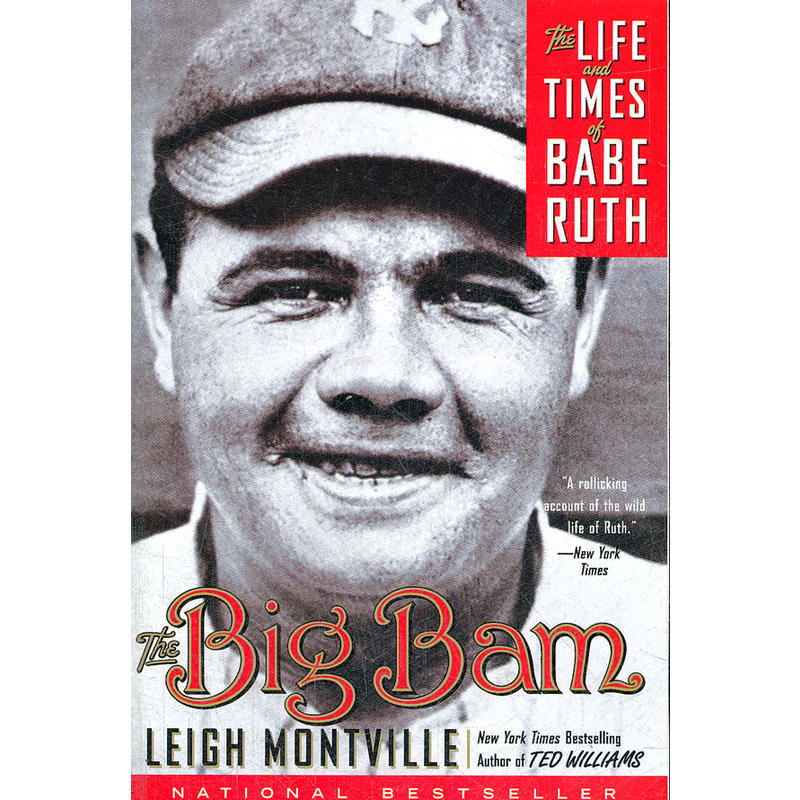
He was the Sultan of Swat. The Caliph of Clout. The Wizard ofWhack. The Bambino. And simply, to his teammates, the Big Bam. Fromthe award-winning author of the New York Times bestseller TedWilliams comes the thoroughly original, definitively ambitious, andexhilaratingly colorful biography of the largest legend ever toloom in baseball—and in the history of organized sports.
“[Montville is] one of America’s best sportswriters.” —ChicagoTribune
Babe Ruth was more than baseball’s original superstar. Foreighty-five years, he has remained the sport’s reigning titan. Hehas been named Athlete of the Century . . . more than once. But whowas this large, loud, enigmatic man? Why is so little known abouthis childhood, his private life, and his inner thoughts? In The BigBam, Leigh Montville, whose recent New York Times bestsellingbiography of Ted Williams garnered glowing reviews and offered anexceptionally intimate look at Williams’s life, brings histrademark touch to this groundbreaking, revelatory portrait of theBabe.
Based on newly discovered documents and interviews—includingpages from Ruth’s personal scrapbooks —The Big Bam traces Ruth’slife from his bleak childhood in Baltimore to his brash entranceinto professional baseball, from Boston to New York and into therecord books as the world’s most explosive slugger and culturalluminary. Montville explores every aspect of the man, payingparticular attention to the myths that have always surrounded him.Did he really hit the “called shot” homer in the 1932 World Series?Were his home runs really “the farthest balls ever hit” incountless ballparks around the country? Was he really partblack—making him the first African American professional baseballsuperstar? And was Ruth the high-octane, womanizing, heavy-drinking“fatso” of legend . . . or just a boyish, rudderless quasi-orphanwho did, in fact, take his training and personal conditioning quiteseriously?
At a time when modern baseball is grappling with hyper-inflatedsalaries, free agency, and assorted controversies, The Big Bambrings back the pure glory days of the game. Leigh Montvilleoperates at the peak of his abilities, exploring Babe Ruth in a waythat intimately, and poignantly, illuminates a most remarkablefigure.








评论晒单