Chapter 1 Introduction to Finite Element Method
1.1 Basic Concept of Finite Element Method
1.2 General Description of Finite Element Method
1.3 Engineering Applications of Finite Element Analysis
1.4 Principle of Virtual Displacements and VariationalApproach
Problem Set 1
Chapter 2 General Procedure of Finite Element Method
2.1 Interpolation Functions
2.2 Strain-displacement Relations
2.3 Stress-strain Relations (Constitutive Relations)
2.4 Governing Equations in Finite Element Analysis
2.5 Stiffness Matrices
2.6 Equivalent Nodal Force Vectors
2.7 Imposition of Boundary Condition
2.8 Numerical Examples
2.9 Area Coordinates
2.10 Six-node Triangular Elements
2.11 Linear Rectangular Elements
Problem Set 2
Chapter 3 Formulation of Isoparametric Finite ElementMatrices
3.1 Isoparametric Concepts
3.2 Construction of Interpolation Functions
3.3 Family of Two-dimensional Isoparametric Elements
3.4 Formulation of Isoparametric Finite Element Matrices for PlaneElasticity
3.5 Isoparametric Triangular Elements in Terms of AreaCoordinates
Problem Set 3
Chapter 4 Stress Analysis of Axisymmetric Problems
4.1 Interpolation Functions
4.2 Strain-displacement Relations
4.3 Stress-strain Relations
4.4 Element Stiffness Matrix
4.5 Element Equivalent Nodal Force Vector
4.6 Four-node Rectangular Ring Element
4.7 A Numerical Example
Problem Set 4
Chapter 5 Analysis of Three-dimensional Problems
5.1 Convergence Considerations
5.2 Shape Functions for Three-dimensional Elements
5.3 Formulation of Three-dimensional Isoparametric ElementMatrices
……
Chapter 6 Finite Element Analysis for Plates and Shells
Chapter 7 Finite Element Analysis in Fracture Mechanics
Chapter 8 Heat Transfer
References
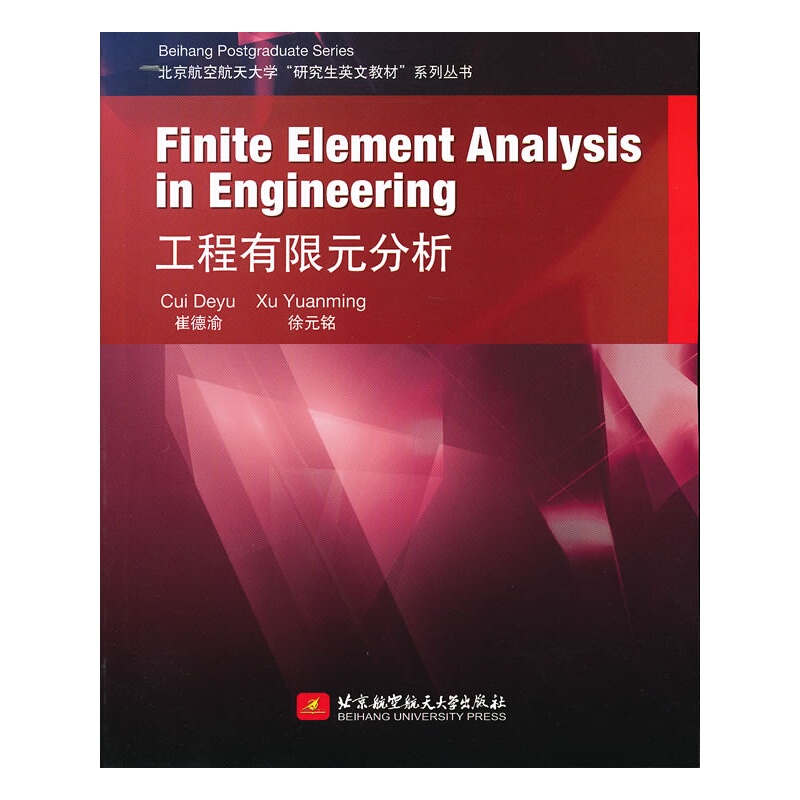
This textbook presents the necessary concepts, principles andgeneral procedure of Finite Element Method (FEM) which areprimarily applied for linearly elastic structural analysisincluding plane problems, axisymmetric problems, space problems,plates and shells and fracture mechanics. The FEM of heat transferin brief is also incorporated. Some straightforward examples areintroduced to demonstrate a complete and detailed finite elementprocedure. The aim of the text is to provide the fundamentaltheories and numerical methodology in finite element analysis. Itfocuses on the derivation of key governing equations of the FEM andits engineering application.
This text can be regarded as a text or reference book for theuniversity under- and post-graduate students or engineers whosemajors are related to mechanics, aerospace, mechanical and civilengineering, heat transfer and so on.








评论晒单