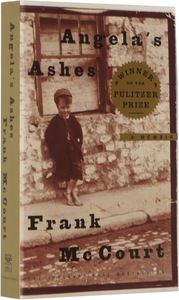
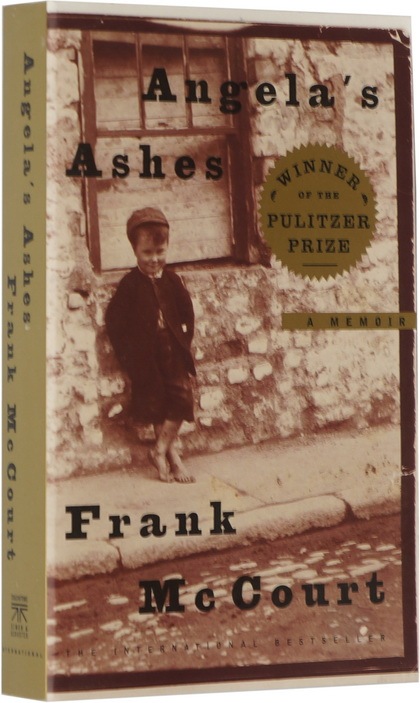
《安琪拉的灰烬》以幽默生动的笔法描述了一个贫民窟孩子成长与奋斗的感人经历。面对贫穷、挫折、苦难,作者迈考特则选择以乐观进取的精神与命运抗争,实现了自己的梦想,成为美国青年一代心目中自强奋斗的偶像。
这本书字里行间充满了苦难,但是它不叫人绝望,主人公在成长着,在拼命地吸吮着苦难的乳汁成长。这成长的历程是无坚不摧的。尽管弗兰克与他的兄弟们在物质上非常贫穷,但他们总是很快乐,有很多渴望,很多梦想,很多激情,感觉很富有。令全世界无数读者为之感动。
该书平凡人的故事深深打动了数以千万的读者,并因此获得了普利策文学奖等多项大奖。本书雄踞《纽约时报》畅销书榜长达117周之久。美国《好书》杂志评论说,“这本书的成功靠的是真心被感动的读者的口口相传”。
《安琪拉的灰烬》不仅是一部关于成长的书,还是一部关于“天使”的书。故事讲述的是一个叫弗兰基的男孩的成长过程。他的成长似乎很不顺利,充满艰辛。从他出生之日开始,他*一直生活在水深火热之中。他的父亲是一个不可救药的醉鬼。他的母亲是一个地地道道地家庭妇女,她的任务*是不停地繁衍后代,然后*是千方百计地支撑这个风雨飘摇的家庭。还有*是一群肮脏的弟弟妹妹。这是一个浑浑噩噩的家庭。那时正在战争,社会环境也十分恶劣……
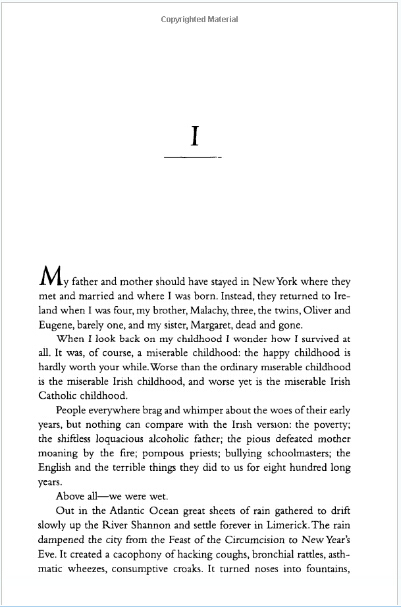
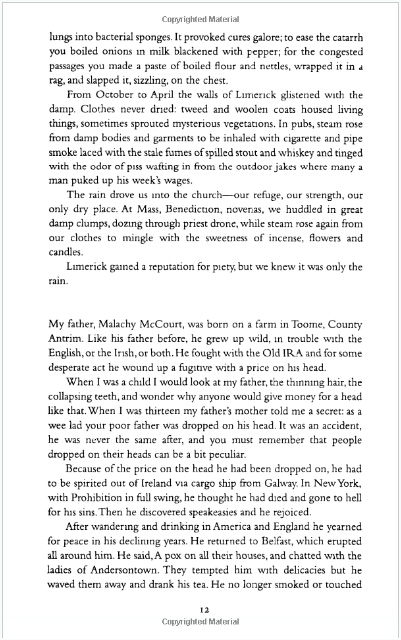
"When I look back on my childhood I wonder how I managed to survive at all. It was, of course, a miserable childhood: the happy childhood is hardly worth your while. Worse than the ordinary miserable childhood is the miserable Irish childhood, and worse yet is the miserable Irish Catholic childhood."
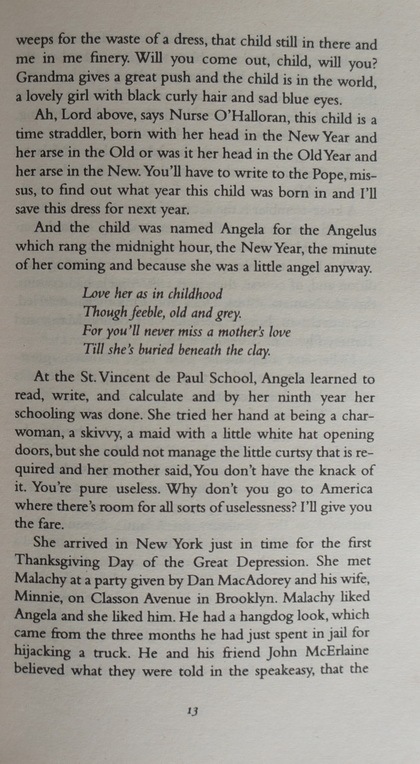
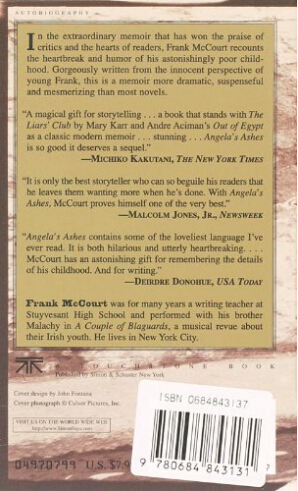
So begins the luminous memoir of Frank McCourt, born in Depression-era Brooklyn to recent Irish immigrants and raised in the slums of Limerick, Ireland. Frank"s mother, Angela, has no money to feed the children since Frank"s father, Malachy, rarely works, and when he does he drinks his wages. Yet Malachy-- exasperating, irresponsible and beguiling-- does nurture in Frank an appetite for the one thing he can provide: a story. Frank lives for his father"s tales of Cuchulain, who saved Ireland, and of the Angel on the Seventh Step, who brings his mother babies.
Perhaps it is story that accounts for Frank"s survival. Wearing rags for diapers, begging a pig"s head for Christmas dinner and gathering coal from the roadside to light a fire, Frank endures poverty, near-starvation and the casual cruelty of relatives and neighbors--yet lives to tell his tale with eloquence, exuberance and remarkable forgiveness.
Angela"s Ashes, imbued on every page with Frank McCourt"s astounding humor and compassion, is a glorious book that bears all the marks of a classic.
*.com "Worse than the ordinary miserable childhood is the miserable Irish childhood," writes Frank McCourt in Angela"s Ashes. "Worse yet is the miserable Irish Catholic childhood." Welcome, then, to the pinnacle of the miserable Irish Catholic childhood. Born in Brooklyn in 1930 to recent Irish immigrants Malachy and Angela McCourt, Frank grew up in Limerick after his parents returned to Ireland because of poor prospects in America. It turns out that prospects weren"t so great back in the old country either--not with Malachy for a father. A chronically unemployed and nearly unemployable alcoholic, he appears to be the model on which many of our more insulting cliches about drunken Irish manhood are based. Mix in abject poverty and frequent death and illness and you have all the makings of a truly difficult early life. Fortunately, in McCourt"s able hands it also has all the makings for a compelling memoir.
From School Library Journal YA. Despite impoverishing his family because of his alcoholism, McCourt"s father passed on to his son a gift for superb storytelling. He told him about the great Irish heroes, the old days in Ireland, the people in their Limerick neighborhood, and the world beyond their shores. McCourt writes in the voice of the child?with no self-pity or review of events?and just retells the tales. He recounts his desperately poor early years, living on public assistance and losing three siblings, but manages to make the book funny and uplifting. Stories of trying on his parents" false teeth and his adventures as a post-office delivery boy will have readers laughing out loud. Young people will recognize the truth in these compelling tales; the emotions expressed; the descriptions of teachers, relatives, neighbors; and the casual cruelty adults show toward children. Readers will enjoy the humor and the music in the language. A vivid, wonderfully readable memoir.
Patricia Noonan, Prince William Public Library, VA
From Library Journal McCourt is the eldest of eight children born to Angela Sheehan and Malachy McCourt in the 1920s. The McCourts began their family in poverty in Brooklyn, yet when Angela slipped into depression after the death of her only daughter (four of eight children survived), the family reversed the tide of emigration and returned to Ireland, living on public assistance in Limerick. McCourt"s story is laced with the pain of extreme poverty, aggravated by an alcoholic father who abandoned the family during World War II. Given the burdens of grief and starvation, it"s a tribute to his skill that he can serve the reader a tale of love, some sadness, but at least as much laughter as the McCourts" "Yankee" children knew growing up in the streets of Limerick. His story, almost impossible to put down, may well become a classic. A wonderful book; strongly recommended for readers of any age.
-Robert Moore, DuPont Merck Pharmaceuticals, Framingham, Mass.
From Booklist It is a wonder that McCourt survived his childhood in the slums of Depression-era Limerick, Ireland: three of his siblings did not, dying of minor illnesses complicated by near starvation. Even more astonishing is how generous of spirit he became and remains. His family lived--barely--in a flat so miserable that every year they had to cram themselves into an upstairs room when winter floods made the place only half-habitable. That upstairs room was "Italy" --warm and dry. Downstairs was Ireland--wet and cold. Father sat up there drinking tea, while mother Angela often could not rise from bed, so depressed was she. Or mother sat by the fire, waiting for father to return; when he did, frequently drunk on their little money, he would line up the boys and extract promises that they would die for Ireland. Dying was what everyone seemed to do best: the little sister, the twins, the girl with whom Frank first had sex, the old man Frank read to, too many boys from school, too many neighbors, too many relatives. McCourt spares us no details: the stench of the one toilet shared by an entire street, the insults of the charity officers, the maurauding rats, the street fights, the infected eyes, the fleas in the mattress . . . Yet he found a way to love in that miserable Limerick, and it is love one remembers as the dominant flavor in this Irish stew. Many a lesser book gets the kind of publicity push that McCourt"s memoir is happily slated to receive. Expect demand, not only from those seduced by blurbs and interviews, but from word-of-mouth thereafter.
Patricia Monaghan
From Audio File You could paper the walls of an Irish castle with the accolades bestowed upon Angela"s Ashes. First, the print version won the Pulitzer Prize. Then Frank McCourt himself narrated the abridged version (celebrated in AudioFile, April/May 1997). But the best was yet to come--the entire book read and sung and recited by author McCourt. Here we have the stereotypical Irish characters--the drunken poet father; the all-suffering mother; the miserable, hungry kids being turned away by a haughty Church--all made three-dimensional and brought fully to life by both McCourt"s language and his loving, intimate narration. "It happened," this voice attests, "I was there." Grim it is--but the tale and its teller transcend the poverty--and so does the listener, who glories in the story and voice from beginning to end. Happily, Mc-Court is at work on a sequel. We eagerly await his next turn at the mike. We eagerly await his next turn at the mike. Winner of AUDIOFILE"s Earphones Award.. A four-tape abridgment also read by Frank McCourt is available. E.K.D.
The New York Times Book Review, Denis Donoghue For the most part, his style is that of an Irish-American raconteur, honorably voluble and engaging.... Induced by potent circumstances, he has told his story, and memorable it is.
From Kirkus Reviews A powerful, exquisitely written debut, a recollection of the author"s miserable childhood in the slums of Limerick, Ireland, during the Depression and WW II. McCourt was born in Brooklyn in 1930 but returned to Ireland with his family at the age of four. He describes, not without humor, scenes of hunger, illness, filth, and deprivation that would have given Dickens pause. His ``shiftless loquacious alcoholic father,"" Malachy, rarely worked; when he did he usually drank his wages, leaving his wife, Angela, to beg from local churches and charity organizations. McCourt remembers his little sister dying in his mother"s arms. Then Oliver, one of the twins, got sick and died. McCourt himself nearly died of typhoid fever when he was ten. As awful and neglectful as his father could be, there were also heartrendingly tender moments: Unable to pay for a doctor and fearful of losing yet another child when the youngest is almost suffocating from a cold, his father places ``his mouth on the little nose . . . sucking the bad stuff out of Michael"s head."" Malachy fled to do war work in England but failed to send any money home, leaving his wife and children, already living in squalor, to further fend for themselves. They stole and begged and tore wood from the walls to burn in the stove. Forced to move in with an abusive cousin, McCourt became aware that the man and his mother were having ``the excitement"" up there in their grubby loft. After taking a beating from the man, McCourt ran away to stay with an uncle and spent his teens alternating between petty crime and odd jobs. Eventually he made his way, once again, to America. An extraordinary work in every way. McCourt magically retrieves love, dignity, and humor from a childhood of hunger, loss, and pain. (First serial to the New Yorker; Book-of-the-Month Club and Quality Paperback Book Club alternate selections; author tour)






评论晒单