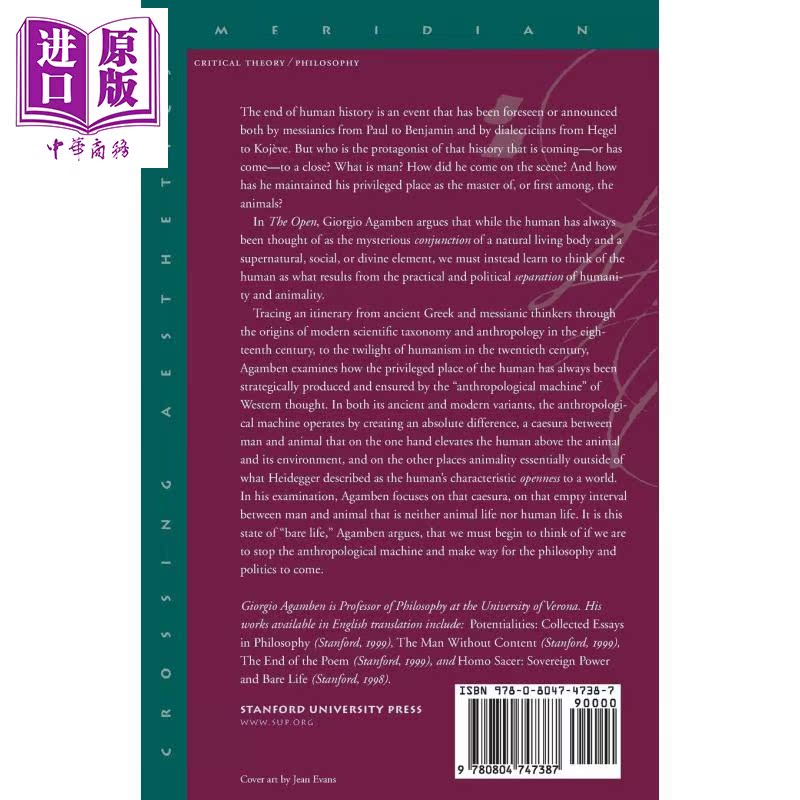
The Open: Man and Animal基本信息Paperback: 120 pagesPublisher: Stanford University Press (31 Jan. 2004)Language: EnglishISBN-10: 0804747385ISBN-13: 978-0804747387Product Dimensions: 140 x 216 x 7.87mm | 154g页面参数仅供参考,具体以实物为准书籍简介The end of human history is an event that has been foreseen or announced by both messianics and dialecticians. But who is the protagonist of that history that is coming or has come to a close? What is man? How did he come on the scene? And how has he maintained his privileged ... 展开完整描述 ▼
The Open: Man and Animal
基本信息
Paperback: 120 pages
Publisher: Stanford University Press (31 Jan. 2004)
Language: English
ISBN-10: 0804747385
ISBN-13: 978-0804747387
Product Dimensions: 140 x 216 x 7.87mm | 154g
页面参数仅供参考,具体以实物为准
书籍简介
The end of human history is an event that has been foreseen or announced by both messianics and dialecticians. But who is the protagonist of that history that is coming or has come to a close? What is man? How did he come on the scene? And how has he maintained his privileged place as the master of, or first among, the animals? In The Open, contemporary Italian philosopher Giorgio Agamben considers the ways in which the human has been thought of as either a distinct and superior type of animal, or a kind of being that is essentially different from animal altogether. In an argument that ranges from ancient Greek, Christian, and Jewish texts to twentieth-century thinkers such as Heidegger, Benjamin, and Kojève, Agamben examines the ways in which the distinction between man and animal has been manufactured by the logical presuppositions of Western thought, and he investigates the profound implications that the man/animal distinction has had for disciplines as seemingly disparate as philosophy, law, anthropology, medicine, and politics.
作者简介
Giorgio Agamben is Professor of Philosophy at the University of Venice. This is the fifth of his books published by Stanford; previous titles are Homo Sacer: Sovereign Power and Bare Life (1998), The Man Without Content (1999), The End of the Poem (1999), and Potentialities (1999).